Thank you for reading! Letters from Leo is a reader-supported publication and the fastest-growing Catholic community in the country. To receive new posts and support this movement, consider becoming a free or paid subscriber.
One housekeeping note before the text: the free copy of Pope Leo XIV’s new book Freedom Under Grace for brand-new yearly subscribers and $80 donors runs through Friday night, and it can only be claimed from the review itself.
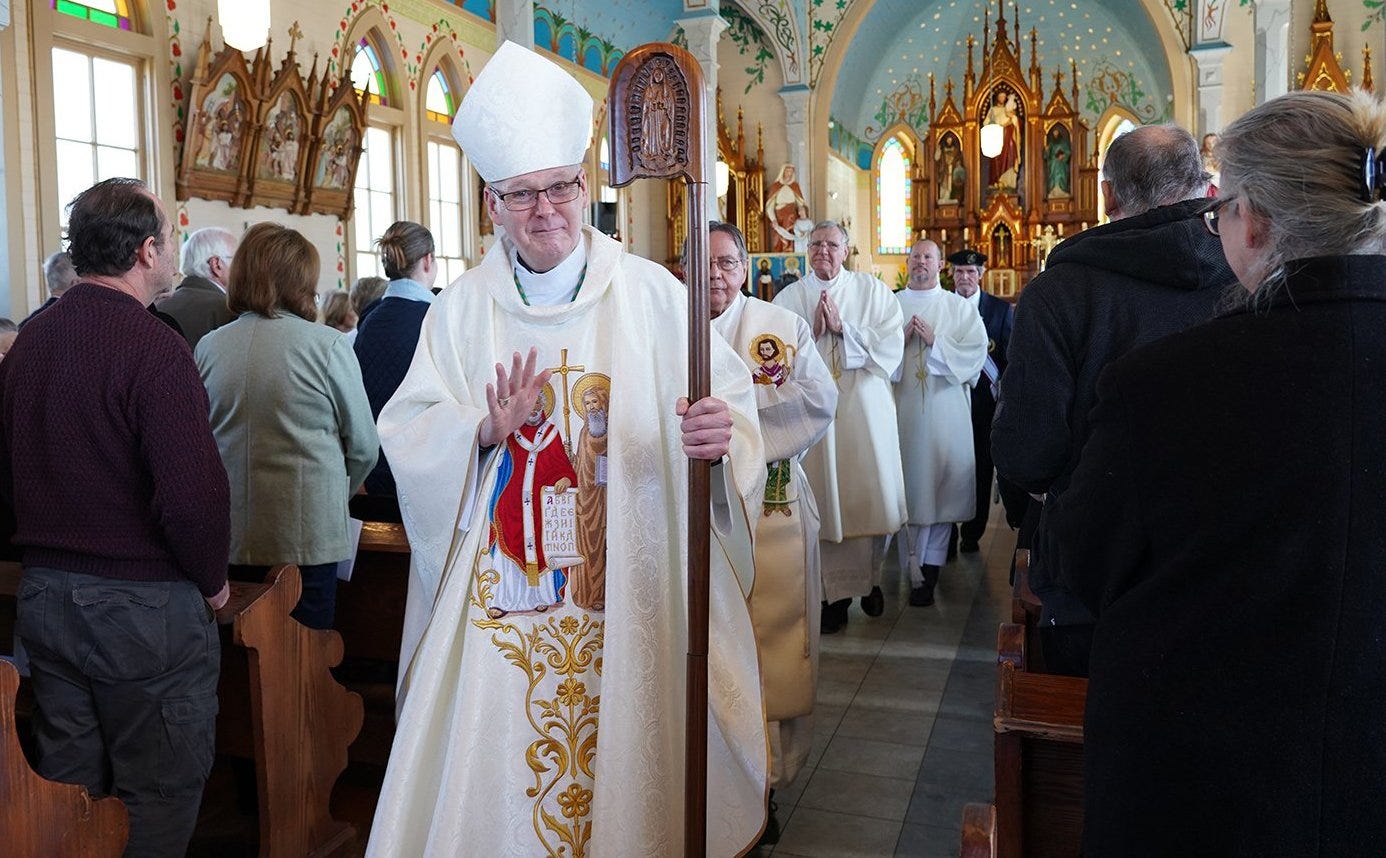
Pope Leo XIV named Bishop Brendan Cahill of Victoria, Texas, the seventh bishop of Joliet on Thursday morning, handing the chairman of the U.S. bishops’ Committee on Migration a diocese of roughly 500,000 Catholics spread across seven counties of suburbs and farm towns west and south of Chicago.
The see had been empty since February 6, when Ronald Hicks left it to become archbishop of New York.
Cahill is 62. Born in Coral Gables, Florida, and raised in Houston from the age of seven, he was ordained a priest of Galveston-Houston in 1990, spent nine years as rector of St. Mary’s Seminary there, and was sent to Victoria by Pope Francis in 2015.
He is fluent in Spanish. Hicks, who led Joliet for five years before New York, called the appointment “a wonderful gift” and described his successor as “a man of deep faith, with the heart of a pastor who walks with those on the margins.”
The margins are where Cahill has spent the past year.
He took over the migration committee in November 2025, as the Trump-Vance raids spread from city to city, and used his first weeks in the chair to launch a national campaign called “You Are Not Alone.”
His explanation of the name was simple: “Human dignity does not depend on immigration status. It is given by God and cannot be taken away.”
This week, ahead of National Migration Week, he warned that protections for migrant children are “being undermined in various ways, including prolonged stays in detention and decreased access to legal representation.”
Cardinal Blase Cupich, whose Archdiocese of Chicago heads the Illinois province that includes Joliet, put out a statement the same day. He thanked the pope for the nomination and then listed what Cahill brings, in an order worth noticing.
“For many years, he has demonstrated his many talents in the areas of migrant justice, interreligious and ecumenical dialogue and priestly formation. It is a particular joy to welcome Bishop Cahill to Illinois, and we know the faithful of Joliet will soon come to know him as a wonderfully gifted pastor who is strong, loving and wise.”
Migrant justice came first on that list, and nobody who has watched Chicago this past year should be surprised. Cupich spent the fall of 2025 fighting ICE in his own streets with the pope’s public backing, and when Reuters asked him in December what Leo’s American appointments added up to, he answered that they signal “a maturing of our understanding of what it means to be pro-life.”
Cahill will now be the suffragan bishop next door.
Joliet was the second American diocese Leo filled in three days.
On Tuesday he named Bishop Michael Saporito, an auxiliary of Newark, to lead Metuchen, New Jersey, a see without a bishop since February, when James Checchio moved up to New Orleans; the same morning he accepted the retirement of Bishop Francis Malone in Shreveport, Louisiana.
I wrote about Saporito earlier this week, because he sat in New Ways Ministry’s closed-door dialogues with LGBT Catholics and said afterward that he “felt enriched by the exchange,” and because the usual outlets spent the day reminding readers who ordained him.
The backlog Leo inherited is shrinking either way.
Six American sees were vacant when the week began, one of them, Steubenville, Ohio, since September 2023. Four of the six emptied in a single month, this past February, and two of those four now have bishops.
The pattern behind these picks was visible from the first month. Leo’s first four American appointments came within two weeks of each other in May and June 2025: Michael Pham to San Diego, Pedro Bismarck Chau as an auxiliary of Newark, Mark Eckman to Pittsburgh, and Simon Peter Engurait to Houma-Thibodaux.
Pham was born in Da Nang, Chau grew up in Nicaragua, and Engurait did not leave Uganda for the United States until 2007. Three of the four, as Aleteia noted at the time, were immigrants.
By May of this year the count stood at 26 American bishops, eleven of them born outside the United States — and none of the eleven from Europe.
Pham is one to watch if you want to understand what Leo is building.
He fled Vietnam as a boy, passed through a refugee camp in Malaysia, landed in Minnesota, and finished up in San Diego with an aeronautical engineering degree before the seminary claimed him.
On June 20, 2025, World Refugee Day, still a month short of his installation, he led a group of priests and a local imam into the federal immigration court downtown to stand beside migrants at their hearings. The ICE agents waiting in the hallways left. “They kind of scattered and went away,” Pham said afterward. “No wonder people come in fear.” Nobody was detained that morning, and the clergy have kept going back.
Chau crossed the border at sixteen, undocumented, fleeing conscription in Sandinista Nicaragua, and worked restaurant and factory jobs before anyone thought of him as a priest.
Speaking to Religion News Service last fall, he said, “I know of the fear that they are experiencing.”
Eckman, the Pittsburgh native and the only one of the four born here, called the administration’s deportation policies “cruel and inhumane” in an open letter last November.
The pattern did not stop with the first four.
On May 1, Leo sent Bishop Evelio Menjívar-Ayala, an auxiliary of Washington, to lead the Diocese of Wheeling-Charleston, which covers all of West Virginia. Menjívar left Chalatenango, El Salvador, in the middle of its civil war and was smuggled through the San Ysidro crossing in the trunk of a car in 1990; he cleaned offices and worked construction, became a permanent resident in 1996, and took citizenship a decade after that. “
I didn’t have the opportunity to come documented, so I did what many, many immigrants were doing,” he told West Virginia Watch after his installation in July, and “just took my backpack and set to the north, undocumented.”
Here is the part the White House has not reckoned with. A bishop keeps his see until 75.
That gives Cahill thirteen years in Joliet; Pham, at 59, has sixteen more in San Diego, and Chau, who has not yet turned 60, could still be wearing a miter somewhere in the 2040s.
Presidents serve four years, and Tom Homan will not be border czar forever. The men Leo is placing in American cathedrals — one appointment at a time, and now two in a week — will be preaching about the stranger at the gate long after the current raids have become a chapter in a history book.
That preaching has a text.
Leo, who spent his own years as a bishop in Chiclayo, Peru, welcoming Venezuelan migrants, told Bishop Mark Seitz of El Paso last October that “the church cannot be silent” about how migrants are treated.
Cahill’s line about dignity is the same teaching in a Texan’s plainer words. Neither man is inventing anything; they are quoting Matthew 25 back to a government that has decided the stranger is the enemy.
The Diocese of Joliet will install its new bishop in November. Its Catholics, from the DuPage County suburbs to the farm towns of Iroquois County, are about to get a shepherd whose first public words as a national leader went to people afraid of a knock at the door.
Cupich called him “strong, loving and wise.” The pope evidently agrees.
At Letters from Leo, we stand with Bishop Cahill, Bishop Pham, Cardinal Cupich, and the growing bench of American bishops who believe, with the pope who appointed them, that human dignity does not depend on immigration status.
In an era when the government treats the stranger as a threat, we remain rooted in a faith that walks into the courthouse and sits beside the frightened.
This is the fastest-growing Catholic community in the country because people are hungry for something deeper than rage and propaganda.
They are looking for courage, for truth, for love made visible in action — and right now, as ICE agents wait in courthouse hallways for families who came to follow the law, that hunger has never been more urgent.
If you believe this movement matters — Catholics and people of goodwill standing for human dignity against a deportation machine that separates parents from children — I am asking you to join us.
If you’d like to invest in our mission, here are three ways you can help:
-
Subscribe as a paid member to receive exclusive posts about the life and formation of Pope Leo and help sustain this newsletter.
-
Donate with a one-time gift to fuel this project’s mission.
-
Share this post (and Letters from Leo) with a friend who might enjoy it.
Paid subscribers receive the full series on Pope Leo’s life and formation, including his years as a migrant bishop in Peru, along with our investigations and the Sunday Scripture Reflection Series.
Whether you give $0, $5, $50, $500, $1,000, or more, your presence here matters — no matter your faith or your politics.
Thank you for reading. I’ll see you on the road.