The Most Expensive Healthcare in the World
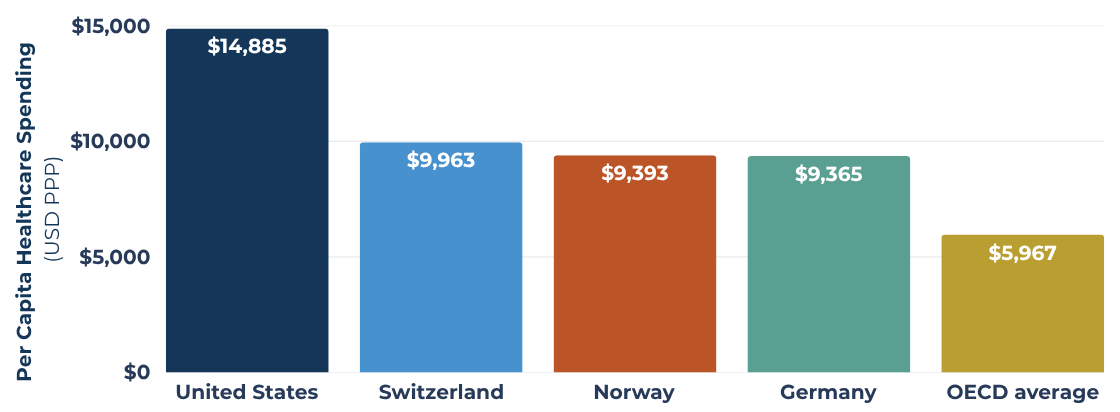
The U.S. spends more on healthcare than any other developed nation — $14,885 per person in 2024, nearly twice what Switzerland spends. At the employer level, that translates to an average total cost of $17,496 per employee in 2025. Family premiums averaged $26,993.
What’s especially frustrating is what you get in return. Despite outspending every peer nation, the U.S. ranks well below them for life expectancy: 79.0 years in 2024 vs. an average of 82.7 years across comparable countries.
Americans pay more and live shorter lives. Something in the system isn’t working, and for employers, that broken system shows up as a bigger bill every January.
What’s Driving Premium Increases?
Health insurance costs are rising on five fronts at once, and they feed on each other. Drug spending climbs while hospital systems consolidate and shed competitors. Insurers gain leverage while fee-for-service keeps rewarding volume over value. Employers, meanwhile, lack the data to push back on any of it. Here’s what’s driving the increase:
Prescription Drug Costs
Hospital Consolidation
When hospital systems acquire physician practices and expand their market footprint, commercial prices follow. A 2025 study found that office visit prices rose 17% after hospital-physician consolidation, and inpatient hospital prices increased 3% to 5% as a result of system mergers. Merged systems gain greater bargaining power with insurers, and employers absorb the difference.
Hospital labor costs remain structurally elevated: around 60% of hospitals’ total expenses go to workforce, and those costs rose another 5.6% in 2025 alone.
Insurance Market Concentration
Fewer carriers competing for your business means higher premiums and fewer plan options at renewal. In 2024, 97% of commercial health insurance markets at the metropolitan level are highly concentrated, up from 95% in 2014. In nearly half of all metro areas, a single insurer controls at least 50% of the market.
Fee-for-Service Payment Structures
The dominant payment model rewards volume, not value. Providers earn more by delivering more services — tests, referrals, procedures — regardless of whether those services improve outcomes. The result is excess spending that flows directly into the premiums employers pay.
Lack of Data Transparency
Employers without claims data cannot act on costs they cannot see. Fully insured carriers routinely raise rates without meaningful explanation to regulators or policyholders, and they don’t provide the visibility into claims data that makes cost containment possible.
That last point is where the leverage begins. Employers who can see their claims data can act on it. The 10 strategies below work in any plan, but they work best when you have the visibility to measure what’s working and adjust before the next renewal.
Learn why fully insured carriers don’t give you access to your data, and what you can do about it.
10 Ways to Lower Your Health Insurance Costs
Employers rarely control cost drivers, but they can control how their plans respond to those costs. These 10 strategies give you practical leverage, from how employees access everyday care to how your plan is funded, and they compound when you use them together.
1. Incentivize primary and preventive care.
The most expensive claims usually don’t appear out of nowhere. They build over years in employees who skip annual check‑ups, ignore early warning signs, or struggle to get an appointment without missing half a day of work.
In many employer plans, roughly 1% of members drive close to one‑third of total costs, which means catching risks early has an outsized impact on your premiums.
Incentives for annual physicals, vaccinations, and age‑appropriate screenings are one of the most direct investments you can make in keeping claims manageable.
2. Implement practical wellness programs.
Wellness programs don’t have to be elaborate or flashy to work. What matters is that they’re easy to use and show up consistently in employees’ lives. In one workplace study, employees at sites with a wellness program were 8.3 percentage points more likely to report regular exercise and 13.6 percentage points more likely to report actively managing their weight than employees at sites without the program.
The program didn’t transform every metric overnight, but it proved that simple, sustained initiatives can change everyday health behaviors that drive long‑term costs.
Advisors: Learn why we guarantee self-funding with Roundstone will save your clients money.
3. Promote health literacy.
Most employees aren’t experts in healthcare, and the system doesn’t make it easy on them. The CDC estimates that nearly nine out of ten U.S. adults have trouble using health information when it’s filled with unfamiliar medical terms and complex instructions.
Improving health literacy could prevent nearly 1 million hospital visits and save more than $25 billion in health care costs annually, according to the CDC. When your team understands their options in plain language, they’re less likely to default to the emergency room, skip preventive care, or make avoidable, high‑cost choices.
4. Encourage cost conversations with providers.
Your employees may assume the price on “the bill is the bill.” It isn’t. Prices for the same procedure can vary widely depending on where care is delivered and how it’s structured. Providers often have lower‑cost alternatives, cash‑pay discounts, and charity programs available, but only if someone asks.
Employers that steer members toward centers of excellence (see #9 below) with bundled pricing see lower complication rates, shorter hospital stays, and lower total episode‑of‑care costs. Coaching employees to ask about options before a procedure, not after, can change both what they pay and what your plan pays.
5. Provide telemedicine as a first line of care.
Access is half the battle. If employees have to take half a day off and drive across town for every visit, they’re more likely to wait until a problem escalates. Telemedicine makes it easier to get timely care for everyday issues, often from home or work.
A recent economic evaluation of telehealth for non‑elderly cancer patients found average indirect savings of about $150–$200 per visit in time and travel costs, with telehealth saving patients more than $1.6 million in lost income over 25,000 visits, along with millions of miles and thousands of hours of driving time avoided.
When you make virtual visits visible and frictionless, “I’ll wait and see” becomes “I’ll schedule a quick video visit,” and claims stay smaller.
6. Steer employees to generics and discount tools.
Prescription drug spending is the fastest‑growing part of your health budget, and brand‑name medications carry brand‑name price tags. Generics often deliver equivalent clinical outcomes at a fraction of the cost. Tools like GoodRx and SingleCare routinely advertise savings of up to 80% off retail cash prices on many medications, especially generics, at thousands of pharmacies nationwide.
A tiered formulary that favors generics, combined with a transparent pharmacy benefit manager and widely promoted discount programs, gives employees a clear path to lower prescription costs without sacrificing treatment.
CFOs: Learn how you can provide better benefits for your employees at lower cost.
7. Consider direct primary care (DPC).
Direct primary care changes how employees access everyday care. Instead of waiting weeks for a brief, rushed appointment, employees get ongoing access to a primary care physician or team for a flat monthly fee, typically with same‑day or next‑day appointments, virtual visits, and no copays for routine care.
Employer case studies of DPC programs have reported roughly 52% lower per‑member‑per‑month costs compared with similar groups on traditional plans, driven by fewer emergency‑room visits, fewer hospitalizations, and better chronic disease management.
For self‑funded employers, DPC becomes a front door to the system that keeps small problems from turning into catastrophic claims.
8. Manage chronic disease proactively.
A small number of high‑cost members account for the bulk of your spend. Recent employer survey data show that about 1% of members can generate close to one‑third of total plan costs, and average spending on high‑cost claimants has jumped by roughly 12% in a single year.
Under a fully insured plan, you have little visibility into who those members are or what’s driving their claims. With access to your own claims data, you can identify rising‑risk employees and put targeted programs in place, like clinical care management, specialty consults, and social support, before manageable chronic conditions turn into catastrophic events.
9. Direct high-cost procedures to centers of excellence.
For high‑cost services like cardiac surgery, joint replacement, cancer treatment, and bariatric procedures, where you send employees matters as much as what the procedure costs. Centers of excellence (COEs) are hospitals and programs that meet specific quality and cost benchmarks for defined procedures, including lower complication and readmission rates, stronger outcomes, and predictable bundled pricing.
Employers that steer eligible members to COEs have documented fewer unnecessary surgeries, shorter hospital stays, faster return to work, and multimillion‑dollar annual savings on complex cases.
10. Shift to a funding model that rewards cost control.
Most of these strategies work best when you can actually see what’s happening inside your plan and change course mid‑year. In a traditional fully insured model, you get a renewal increase and a vague reference to “market trends.”
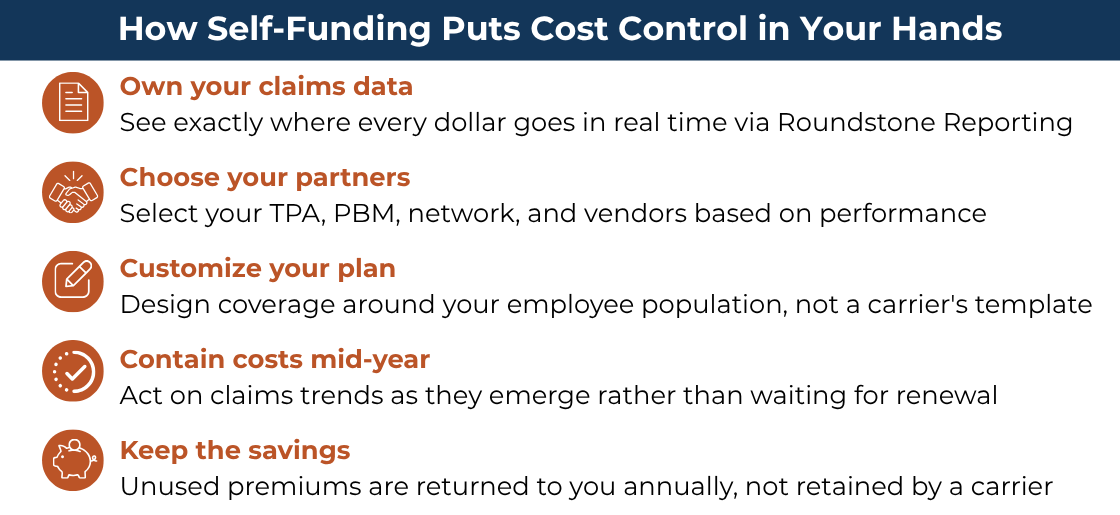
In a self‑funded arrangement, especially one built around a group captive, you own your claims data, choose your provider network, and decide how aggressively to pursue cost containment strategies. When unused premiums are returned to you instead of retained by a carrier, the incentives finally point in the same direction you do: lower costs and better care.
The Most Effective Step: Self-Funding with Roundstone
Most of the strategies above deliver their greatest impact when you own your data and control your plan design. A self-funded group captive plan through Roundstone gives you both.
Roundstone’s group medical captive pools hundreds of small to midsize businesses together, so companies with as few as 25 employees can access the risk stability of a Fortune 500, with full data transparency, flexible vendor choice, and unused premiums returned to you at year’s end.
Employers in the Roundstone captive consistently outperform industry benchmarks on healthcare costs year over year. Members save an average of 20% over a traditional fully insured plan. Unused premiums are returned to captive members annually, and we back our model with a five-year savings guarantee.
Stop absorbing annual premium increases and start building a plan that works in your favor. Contact a Roundstone rep to learn more about how Roundstone helps employers lower healthcare costs, guaranteed.
Frequently Asked Questions About the Rising Cost of Healthcare
Costs rise because the system rewards volume over value, hospital and insurer consolidation reduces competition, and drug prices grow faster than any other category. Employers absorb most of the increase at renewal with little explanation.
Larger employers have more bargaining power and can spread risk across bigger employee populations. Smaller companies pay higher per-person rates and have fewer options to push back on carrier pricing at renewal.
Employers cover roughly 75% to 83% of premiums on average. In 2025, total annual premiums averaged $17,496 per employee for single coverage and $26,993 for family coverage.
A group medical captive pools multiple employers together to self-fund health benefits, share risk, and access claims data. Members pay lower fixed costs, choose their own vendors, and receive unused premiums back at year’s end.
In a fully insured plan, a carrier sets premiums, retains unused funds, and controls plan design. In a self-funded plan, the employer pays claims directly, owns the data, and keeps what it doesn’t spend.
A PBM manages prescription drug benefits on behalf of an employer or insurer, negotiating drug prices and building formularies. A transparent PBM aligns its incentives with the plan; an opaque one may not.
Results vary, but employers in well-managed self-funded arrangements commonly report savings of 10% to 20% compared with fully insured plans, with additional upside from unused premium returns and targeted cost containment.
A center of excellence is a hospital or clinical program that meets defined quality and cost benchmarks for specific procedures. Steering employees to COEs typically produces better outcomes, fewer complications, and lower total costs per episode.
Carriers are not required to provide detailed claims-level data under fully insured arrangements, and doing so would make it easier for employers to challenge renewal rates. Data opacity benefits the carrier, not the plan sponsor.
{“@context”:”https:\/\/schema.org”,”@type”:”FAQPage”,”mainEntity”:[{“@type”:”Question”,”name”:”Why do U.S. health insurance costs keep rising each year?”,”acceptedAnswer”:{“@type”:”Answer”,”text”:”Costs rise because the system rewards volume over value, hospital and insurer consolidation reduces competition, and drug prices grow faster than any other category. Employers absorb most of the increase at renewal with little explanation.”}},{“@type”:”Question”,”name”:”Why do small and midsize businesses pay more for health insurance than large companies?”,”acceptedAnswer”:{“@type”:”Answer”,”text”:”Larger employers have more bargaining power and can spread risk across bigger employee populations. Smaller companies pay higher per-person rates and have fewer options to push back on carrier pricing at renewal.”}},{“@type”:”Question”,”name”:”What percentage of healthcare costs do employers typically cover?”,”acceptedAnswer”:{“@type”:”Answer”,”text”:”Employers cover roughly 75% to 83% of premiums on average. In 2025, total annual premiums averaged $17,496 per employee for single coverage and $26,993 for family coverage.”}},{“@type”:”Question”,”name”:”What is a group medical captive, and how does it lower costs?”,”acceptedAnswer”:{“@type”:”Answer”,”text”:”A group medical captive pools multiple employers together to self-fund health benefits, share risk, and access claims data. Members pay lower fixed costs, choose their own vendors, and receive unused premiums back at year’s end.”}},{“@type”:”Question”,”name”:”How does self-funding differ from a fully insured health plan?”,”acceptedAnswer”:{“@type”:”Answer”,”text”:”In a fully insured plan, a carrier sets premiums, retains unused funds, and controls plan design. In a self-funded plan, the employer pays claims directly, owns the data, and keeps what it doesn’t spend.”}},{“@type”:”Question”,”name”:”What is a pharmacy benefit manager (PBM), and why does it matter for costs?”,”acceptedAnswer”:{“@type”:”Answer”,”text”:”A PBM manages prescription drug benefits on behalf of an employer or insurer, negotiating drug prices and building formularies. A transparent PBM aligns its incentives with the plan; an opaque one may not.”}},{“@type”:”Question”,”name”:”How much can employers realistically save by switching to a self-funded plan?”,”acceptedAnswer”:{“@type”:”Answer”,”text”:”Results vary, but employers in well-managed self-funded arrangements commonly report savings of 10% to 20% compared with fully insured plans, with additional upside from unused premium returns and targeted cost containment.”}},{“@type”:”Question”,”name”:”What is a center of excellence in health insurance?”,”acceptedAnswer”:{“@type”:”Answer”,”text”:”A center of excellence is a hospital or clinical program that meets defined quality and cost benchmarks for specific procedures. Steering employees to COEs typically produces better outcomes, fewer complications, and lower total costs per episode.”}},{“@type”:”Question”,”name”:”Why don’t fully insured carriers share claims data with employers?”,”acceptedAnswer”:{“@type”:”Answer”,”text”:”Carriers are not required to provide detailed claims-level data under fully insured arrangements, and doing so would make it easier for employers to challenge renewal rates. Data opacity benefits the carrier, not the plan sponsor.”}}]}